Curated by Anna Fech
Caspian Corporealities
-
One-minute excerpt from Iceless Horizons (2025), 3D animation, 5 min., loop.
Gaini Sagidullayeva’s Iceless Horizons is a video essay told from the imagined perspective of the endangered Caspian seal. Through archival footage, AI-generated visuals, and original 3D animation, the work layers past and possibility. It invites viewers to experience the world from the seal’s perspective, as both witness to and survivor of human presence, ecological change, and disappearing ice.
Courtesy and copyright by the artist.
YARAT Contemporary Art Space: Performance Week
15 Jul - 19 Jul
2025
-
Artists: Aliya Gadirova, Lena Pozdnyakova and Eldar Tagi, Ilgar Aydin, Rovshan Guliyev, Inga Allakova, Gaini Sagidullayeva-Abay, Jeyran Musayeva, Ramil Aliev, Darya Safarova, Javid Hasanli, Zarif Bakirova and Ulkar Aliyeva.
The first edition of the YARAT Performance Week, entitled Caspian Corporealities, explores the body's interaction with the waters of the Caspian Sea and raises the question of whether and how we move with the sea, or how the sea moves us. The title references Stacy Alaimo's concept of transcorporeality, which aligns with the New Materialist view that matter, including water, possesses its own agency and actively shapes reality. Water is the element that most vividly reveals that there is no true dichotomy between nature and culture: we are composed of nearly 70 percent water, and our bodies embody the fluid transition between inside and outside, the self and the other.
Attempts to define what the Caspian Sea actually is reveal the limits of human conceptualization. Is it a sea, or the world's largest inland lake? Its numerous historical names - Mazandaran Sea, Khvalis Sea, Hyrcanian Sea, Sea of the Rising Sun, Abbacuch Sea, Mar de Sala, Kumyk Sea, Tarki Sea - witness the layered histories and changing cultural geographies of the peoples who have lived along its shores. The artistic contributions explore both personal and collective experiences, addressing social, ecological, mythological, and industrial themes. Many of the works focus on the decline in sea levels and the serious consequences this might have in the future. At the same time, the performances offer hope and ask whether our ability to change - including the use of contemporary tools such as artificial intelligence - can help us rethink and improve our relationship with the environment. The program also highlights the diverse communities around the Caspian Sea. Inspired by Azerbaijani poet Rasul Rza, who saw water as a mirror of deep inner states, the artists treat water as a thoughtful, reflective presence. By collecting impressions and personal stories, they allow water to speak through its various colors and emotional reflections. In doing so, water is transformed into a poetic voice - intangible, anti-dogmatic, and multilayered.
Caspian Corporealities invites audiences to reimagine the body not as separate from the environment but as deeply entangled with it. Through performances, multisensory participatory works, workshops, and lectures by local and international artists and scientists, the week creates a space for reflection on fluid identities, ecological interdependence, and the significance of the Caspian waters in their specific geopolitical context today.
Curated by Anna Fech
I might be staring at infinity (or the backs of my own eyelids)
-
Courtesy of YARAT Contemporary Art Space
Video by Sarkhan Rajabov
Artim Project Space: Virtual Exhibition
22 May - 22 Aug
2020
-
Artists: Leyli Ahmadova, Murad Akbarli, Aghababa Baghirov, Natig Asgar, Kateryna Bortsova, You Open a Box (Art Collective), Joshua Dyson, Lukasz Horbow, Laura Ige, Nathan M. Collis, Martina Morger, Rehan Miskci, Forough Noei, Florian Nitsch, Jay Rechsteiner, Quafar Rzayev, Nadya Sayapina, Julia Smirnova, Aline Schwibbe, Pudji Utomo, Nina Traub & Lukas Zerbst.
Join us in the virtual ARTIM project space located on a spaceship that crosses the universe; it left earth as life on the planet became impossible. You are invited to see group show "I might be staring at infinity (or the backs of my own eyelids)", which reflects on the coronavirus pandemic of 2019/2020 and features different reactions of Earth's inhabitants to the extraordinary situation, recalling one of the disasters that forced humanity to seek alternatives for living. Before entering the show, you will be able to create avatars as hybrids at the intersection of artificial intelligence, machines and humans.
The title, as well as the conceptual layer of the show, loosely draws on the science fiction novel “Quarantine" (1992) by Greg Egan, set in the near future 2034-2080 when the solar system has been isolated in a bubble for unidentified reasons, causing widespread societal panic, 'claustrophobia' and terrorist action. To overcome the psychoses, advanced bio- and nanotechnology is used in which completely new possibilities such as neural mods are installed in the brain, producing a variety of effects such as particular skillsets, different emotions, and altered states of awareness but also illegal control systems. The novel aligns with theories of quantum mechanics about parallel events, the significant role of the expectations of the observer, as well as human brain wave power being able to collapse the whole system. The exhibition space reflects this metaphysical point of view; visitors are able to wander around the different emotional states, exploring varieties of possibilities that are happening in parallel among others, experience the desire to break free from controlling systems, and a final blurred state.
The featured works by emerging artists show different possible and impossible conditions and positions among the backdrop of quarantine due to the global Covid-19 crisis. Among them, a depressed, rather dark mood of loneliness triggered by isolation that found a form of artistic expression in an increasingly flowing digital and physical creativity is displayed. Likewise, voices who see virtual space as a new opportunity for experience and adventure are represented, but they also critically reflect upon artificial self-representation and question exaggerated pathetic positions on social media. Works that document the beauty of everyday life form a further level of meaning. In a humorous or documentary way, they make the trivial things of everyday life something 'special' and stimulate reflection on the enjoyment and beauty of the little things. A section is also devoted to the drama of life, which furthermore questions stereotypical representations of gender. How do our mood swings express themselves? In emotional outbursts or maybe retreat? Another level shows how a sense of community and togetherness can be created and lived in during times of isolation when, for example, artists invent forms of creative cohesion while being locked in artist-in-residences. Peace and quietness are also a parallel state, once the bed sheet becomes a flag of peace and we may find the state of harmony through a white labyrinth. On one hand, the standstill imposed from the outside cause’s voices of dissatisfaction, desire and gestures of rebellion. On the other hand, everyday noises are transformed into a vibrating, dissolving space that suggests infinite dimensions. It is up to us to decide what or who generated these states: our brain, an emotional mode of artificial intelligence or a matrix that can only be understood from another dimension of perception?
Curated by Anna Fech and Farah Piriye
Fragile Frontiers - Visions On Iran’s In/Visible Borders
-
The idea for this series emerged during the artist’s residency at Künstlerhaus Bethanien in Berlin. Nine thousand used gloves belonging to Iranian oil workers were collected over two years. They were then assembled into giant netlike structures and installed on buildings that were historically related to the oil industry. Oil has been the main source of income for Iran and other Middle Eastern countries since it was discovered and first extracted by the British colonial power in the early twentieth century. But it has also been linked to a general decline of local economies and societies. In Iran, the 1953 coup d’état (aided by the United Kingdom and the United States), the Islamic Revolution of 1979, and the war with Iraq (1980–88) were all directly related to oil, bearing witness to its strategic significance in the global economy. After the controversial reelection of Mahmoud Ahmadinejad in 2009, although oil income was at an all-time high, the country was hit by record inflation and widespread corruption, the consequences of which can be felt to this day. In much the same way as empty tables and empty hands signify poverty, the worn-out, oil-soaked gloves referred to the dire situation of Iran’s industrial workers. They had been woven together into a textured web that ‘covered’ the buildings and their fraught history, while symbolically forming a collective hand raised in a gesture of defiance. It is particularly telling that the workers of the governmentowned National Iranian Oil Company helped the artist collect and assemble the gloves. The installation has been exhibited in, and adapted to, various contexts:
Apprentice Training Center Museum Abadan, Iran, March 2019 On 26 May 1908, a large oil field was discovered in the western part of Iran. In the following decades, it was exploited by the AngloPersian Oil Company (APOC), the predecessor of British Petroleum (BP). To satisfy the growing demand in skilled workers, the company decided to build a training centre in Abadan. It was completed in 1933 and has since witnessed numerous events linked to the turbulent history of Iran’s oil reserves, from workers’ strikes and the nationalisation of the oil industry to the Islamic Revolution and the Iran–Iraq War. In 2013, the building was eventually developed into a museum. With Presence of an Absence, Hodaei did not only pay tribute to the history of the building but also to the workers of the Abadan refinery, who helped her implement the work. By literally interweaving her art with their everyday life and work, she paid homage to the city in which she had spent her childhood years.
Darvazeh Dowlat Petroleum Museum Tehran, Iran, October 2019 Darvazeh Dowlat Gas Station was established in 1932 by the AngloIranian Oil Company in order to distribute petroleum products. After being abandoned for years, it reopened in 2019 as a museum, soon after the creation of the Petroleum Museum and Documents Center of the Iranian Oil Industry. Presence of an Absence was set up over the course of a week in the former petrol station with the help of its dailywage workers. Since the museum is located next to one of the city’s busiest metro stations, the installation prompted a lot of interaction from passersby. However, for lack of funding, their reactions could not be documented. Moreover, permission to use the two buildings in Abadan and Tehran had been granted only after a long bureaucratic process and was restricted in time.
YARAT Contemporary Art Space Baku, Azerbaijan, 2019–2020 YARAT is an art organisation based in Baku, Azerbaijan, another country with a long oil history. At the artist’s request, gloves of Iranian and Azerbaijani oil workers were gathered, assembled and installed on the outer walls of the museum building. Also on display for the time of the installation was archival material related to workers who had migrated to Azerbaijan when oil was discovered there, prompting an unprecedented economic boom. The documents revealed the otherwise invisible identity of this workforce and the patterns of economic migration.
Vahdat Hall Tehran, Iran 2021 Formerly known as Roudaki Hall, Vahdat Hall is one the largest venues for live art in Iran. It was inaugurated in 1967, towards the end of the Third Development Plan, which coincided with an unprecedented influx of oil money.Presence of an Absence was exhibited there as part of the 8th Tehran National Sculpture Biennial. It was the first time that it was staged in an indoor setting. Despite numerous difficulties, it eventually launched but was shut down soon afterwards following an emergency visit by the speaker of the Islamic Consultative Assembly.
© Samira Hodaei
Courtesy YARAT Contemporary Art Space
Images by Fakhriyya Mammadova
YARAT Centre
22 Nov - 16 Feb
2020
-
Artists: Nazgol Ansarinia, Kamrooz Aram, Dadbeh Bassir, Samira Eskandarfar, Ghazaleh Hedayat, Samira Hodaei, Gelare Khoshgozaran, Robin Mandel, Ali Momeni, Timo Nasseri, Jaleh Nesari, Navid Nuur, Leila Pazooki, Sara Rahbar, Neda Razavipour and the old master Mirza Kadym Irevani.
The exhibition brings together newly commissioned and recent works by 15 artists who understand frontiers as precarious, ephemeral or frictional, arguing that no border – whether cultural, territorial or psychological – is completely durable. Examining the dilemma of borders within the Iranian context, alongside its neighbouring nations, the show raises questions about political identity as well as internal, interpersonal and international boundaries.
The exhibition’s title is inspired by the essay Fragile Frontiers: The Diminishing Domains of Qajar Iran by Professor Firoozeh Kashani-Sabet, which outlines two types of frontiers: literal, physical separation, and metaphorical ‘cultural’ boundaries. The exhibition at YARAT sheds light on non-violent divisions, that nevertheless disrupt constructive dialogue, uproot collective consciousness and negate common history, faith and culture.
On the first floor, the show explores the invisible frontiers between body space and city space; chaos and order; social and personal space; ‘I’ and ‘other’. Kamrooz Aram’s new multi-media work Elegy of Blue Architecture (2019) contains multiple cultural references from Iran, Azerbaijan and Afghanistan - countries united by a Persian heritage – through various materials and forms. Aram explains, ‘If the object in question is hundreds of years old and the borders that delineate nations have shifted and evolved over centuries, then the claim of national origin assigned to an object is dubious (geographic and national origin, of course, are not necessarily the same).’ His installation is set in dialogue with a masterpiece by Azerbaijani portraitist Mirza Kadym Irevani, famous for his “typical” Persian miniatures. Leila Pazooki’s work Untitled – Room #3 (2012/2019) also explores the notion of barriers: ‘Unwritten rules, social and cultural taboos, conservative and traditional limitations, laws that we are not familiar with – those are all invisible borders we encounter every day, boundaries we don’t realise we cross each minute.’
In response, the second floor offers a counter-position, focusing on the experience of boundlessness and exploration beyond physical limits, referencing elements of nature: earth, sky, water. An immersive marble and mirror gateway by artist Navid Nuur acts as a mediator of time, creating an entrance to a parallel universe. The cosmos is also discussed in Timo Nasseri’s commissioned work It’s always night, or we wouldn’t need light (2019), tracing the starry sky with small, black stone grains, dissolving and disappearing in the course of time. In her commissioned work The fluid body (2019), Neda Razavipour investigates the notion of inner/intimate memory and collective memory, related to her childhood spent on the shores of the Caspian Sea. The sound and video installation documents true stories gathered by the artist from Astara to Jolfa, Iran, including tales of people separated by the Aras river border. The Aras river border has also inspired the newly commissioned video by Jaleh Nesari, who whispers verses from poet Nizami Ganjavi, well known for his masterpiece Leili and Majnun (1188), where the protagonists bemoan their forced separation.
Curated by Anna Fech and Suad Garayeva-Maleki
Babi Badalov:
ZARAtustra
-
Images by Pat Verbruggen
Courtesy YARAT Contemporary Art Space
YARAT Centre: Solo Show
02 March - 16 June
2019
-
YARAT Contemporary Art Space presents “ZARAtustra,” a solo exhibition by visual artist and poet Babi Badalov. Born in Azerbaijan and living in France since 2008, Badalov’s practice explores the complexities and limitations of language and expressions of gender and sexuality. At YARAT the artist presents an installation made entirely of existing and newly commissioned textile works, offering a timely observation on the conflicts between Azerbaijan's cultural heritage and the contemporary climate of accelerated capitalist growth within the country
Having spent much of his life migrating between various countries and cultures, Badalov’s work is informed by his own personal experiences of exclusion – particularly with regards to gender and sexuality – whilst also alluding to broader geopolitical concerns.
Using a process akin to automatic writing, Badalov’s urgent and organic text-based works present multiple languages to construct his distinct visual poetry, forming cleverly nuanced slogans and socio-politically charged puns. The exhibition’s title, “ZARAtustra”, is itself a portmanteau of the global high street brand (ZARA) – synonymous with contemporary fast-fashion – and the ancient Persian prophet Zarathustra (whose teachings developed into the religion Zoroastrianism) – still a major influence on the history and culture of Azerbaijan today; the title, like the work itself, thus plays within the gaps between contemporary and traditional structures, from language and beyond.
Often using fabric as a medium for his work, the installation at YARAT comprises approximately 250 textiles hung in rows suspended from the gallery ceiling. Utilising old sheets, pieces of curtains and found materials, each textile is overlaid with Badalov’s poetic texts. Evoking the production line process of an industrial factory, the immersive installation locates the viewer within the contemporary landscape of fast fashion and mass production, whilst raising issues related to our more traditional and historically rooted constructs of self.
Presenting a departure from the textile works, a wall-based intervention from the artist similarly questions narratives surrounding people and places. Presenting handwritten slogans and texts across the gallery wall, it becomes both a physical representation of geo-political boundaries, and a metaphor for the limits of language itself. The work is the latest in a series of recent pieces the artist has completed for exhibitions internationally.
Babi Badalov (b.1959, Lerik, Azerbaïjan) lives and works in Paris. Solo exhibitions include Je Suis Mazimir Kalevich, New Museum, St. Petersbourg (2018); Quand la Litterature Sort du Livre, Festival Extra, Centre Pompidou, Paris (2018); Refugee Politic Refugee Poetic, National Museum of History of Immigration, Paris (2017); To Make Art To Take Clothes Off, MUSAC – Museum Contemporary Art, Leon (2017); For the Wall For the World Palais de Tokyo, Paris (2016); Partisanism, Tensta Konsthall, Stockholm (2016);MIGRANT POETRY, La Station, Center for Contemporary Art, Nice (2015) and FUCK GOLF, Kunstraum Munich (2015). Badalov has also participated in biennials and arts festivals accross the globe such as the 5th Rennes Biennale (2016), 11th Gwangju Biennale (2016), 6th Moscow Biennale (2015), 15th Jakarta Biennale (2013) and Manifesta 8 (2010). Babi Badalov is represented by Galerie Jérôme Poggi, Paris since 2014.
Curated by Anna Fech
Performance Program in Response to Zadie Xa’s Child of Magohalmi and the Echos of Creation
-
My Mother Is the Mother in Meis a performative investigation into the transmission of female identity, where inheritance operates not only as continuity but also as a mechanism of repetition and constraint. The work was realized in the context of Zadie Xa’s Child of Magohalmi and the Echos of Creation at YARAT Contemporary Art Space, entering into a dialogue on the level of origin, mythology, and collective memory. Within this field, the performance exposes a paradox: the woman, as a carrier of memory, is simultaneously embedded within a system that suppresses deviation. Identity emerges here not as an individual given, but as a condition shaped through repetition, obligation, and embodied memory.
Commissioned by YARAT Contemporary Art Space. Courtesy of YARAT Contemporary Art Space and the artist.
Video by Sarkhan Rajabov.
YARAT Centre
12 July - 29 September
2019
-
Opening Performance directed by Katja Verheul (Performers: Quliyeva Aydan, Quliyeva Ismat, Liel Djalilova)
The performance is inspired by the magic of the public cleaning ladies who fearlessly cleanse the streets of the city with their brooms. They are equated with white witches who use their spells to keep the city from dark devastation. As if from another time, these enigmatic women stand in sharp contrast with the modern appearance of the city. They are sweeping the way with delicate but also determined movements, which in a few seconds becomes dusty again, reminding of poetic Sisyphus workers who have vainly committed themselves to social cleansing in a capitalist world.
July 18, 19:00
Performance “Awakening” by Rumiya AgayevaThe artist is interested in the universalistic tendencies of shamanism, she seeks commonalities in local culture with spiritual orientations such as the rituals of Sufi dervishes, Neopaganism and a modern revival of ancient religions of indigenous people of the Caucasus. The performance enacts the traditional practices of local people reflected in their folklore related to shamanism.
July 25, 19:00
Screening of the video “Origin” by Shalala SalamzadehThe video work “Origin” reflects on the absence of bright female characters in Azerbaijani fairy tales telling the story of the goddess Humai. In ancient Azerbaijani mythology there is a legend about the world consisted only of endless seas and the goddess Humai in the form of a half-woman, half-bird. Contrary to the widespread beliefs of the anthropomorphic male creator, it was in Azerbaijani mythology that Humai was the creator of the earth, the world of flora and fauna. Another tradition glorifies the proud and strong spirit of the goddess, who, having flown around the entire globe, hiding her exhaustion, returns to the Supreme God, which strikes him with her steadfastness of spirit. References to the goddess Humai are also found in the works of the poet Nizami.
August 1, 19:00
Performance “Я у мамы мамочка“ (“My mother is the mother in me“) by Shahnas AghayevaWomen pass genealogical information from each generation to the other generation, however, non-conformist behaviour of a woman in a family is absolutely not welcome and resistance is responded with aggression. The younger generation is obliged to continue the absurd comedy that has long been started. The concept of the performance “My mother is the mother in me” allegorically tries to show this absurdity with actresses who are obliged to continue to demand further in the future generation of a stencilled behaviour.
August 8, 19:00
Performance directed by Elvin MirzayevThe performance will enact the story of a drowned city told by the sea spirit. The spirit is represented by a woman who remembers the last day of Sabail city. While Sabail district is an ancient dwelling of Baku city, it was formed as an administrative territorial unit since 20s of the last century. The district previously carried names such as "Bayil Bibi-Heybat", "Stalin" from 1931, "26 Baku Komissarlari" from 1960 and Sabail district since 29 April, 1992. Sabail is the name of a historical monument located 350 meter south-west of the coast of Baku bay. There are monuments dating back to the ancient age and medieval centuries in the territory of the district.
September 5, 19:00
Performance by Diana HadjievaDihaj is an experimental doom pop project based in Baku, Azerbaijan. The artist associates the underwater motives with deep harmonies and mid low tempo. The performance will feature a half improvised one hour set which will combine acoustic drum sound with electronic kick, immersive guitar reefs and volumetric pads, breathy vocals would change for shamanic descants.
September 19, 19:00
Performance by Dance Ability Azerbaijan-Inclusive Dance CompanyThe performance explores how grand mothers behaviour and her story telling affects the life of her daughter as well as their mutual approaches to live. Some of the stories passed from one generation to the other might create fears, shaping the collective consciousness and creating new stories and lives of anxiety. The performance aims to visualize these stories that affect culture both in a negative and positive way.
September 26, 19:00
Videoscreening and Soundperformance of “Runanshah” by Farhad FarzaliyevThe artist will screen his work Runanshah which is a presentation of the results obtained so far in the author’s on-going investigation into the Runanshah – a fish-tailed being that, according to eyewitness reports, lives in the Caspian Sea. The roots of this story go back into mythology – to the bewitching images of mermaids in the fairy tales and myths of the Eastern Slays, as well as to the amphibious creatures of Mesopotamian folklore which were simultaneously akin to both people and fish. According to legend, these latter emerged from the waters to teach their skills and knowledge to the inhabitants of the land. After the presentation the artist will perform a sound set with music related to the topic in a dolphin costume representing the figure of Runanshah.
September 29, 19:00
Closing performance “That's why I don't hang with cool kids” directed by Agil AbdullayevThat's why I don't hang with cool kids - is both sound and performance work that attempt to examine the relationship between local ravers and old traditional Karabakh sounds that always had an important place in local culture and stood out by its antiquity and originality. Since ancient times these sounds were used in public celebration and spiritual processions. Starting from the first half of the 19th century the performing artists evolved rapidly becoming famous whole Transcaucasia forming its inexhaustible school of folk and music talents. Agil has created a contemporary interpretation of the antique sounds, and constructs atmospheric sound environments with inhabited by groups of friends where they will take over space with performances that combine music, antiquity, westernized club scenes and choreographed gestures.
Curated by Anna Fech
Boundary Layers
-
A split-screen video installation, 7: 26 min (here excerpt)
Set in the Caucasus Mountains Evy Jokhova’s film 'In this hot desert I miss the snow' explores the invention of tradition, memory, personal histories and relationships with landscape and culture.
The underpinning background to this project are a number of personal stories of economic and political migration, the yearning for a reconnection with one's culture of origin and family history and a nostalgic love for the mountains experienced through dislocation. Rooted in the artist's personal relationship with the Caucasus through narrative and research on Caucasian rituals and traditions the film work and installation navigate the relationship between land, site and society. With specifically made props and costumes a contemporary ritual set in Khizi and Gobustan is choreographed and performed by Azerbaijani actresses Nargila Qaribova and Rumiya Agayeva. Original score by Farhad Farzaliyev.Commissioned by YARAT Contemporary Art Space. Courtesy of YARAT Contemporary Art Space and the artist.
ARTIM Project: YARAT Residents group Show
14 December - 19 January
2019
-
Artists: Evy Jokhova (UK/Russia), Aurélien Lepetit (France/Netherlands), Emil Mejnun (AZ), Aydan Mirzayeva (AZ), Giuditta Vendrame (Italy/Netherlands)
The term "Boundary Layer" refers to a thin layer in fluid mechanics of a liquid or gas in contact with a stable surface, which is subject to shearing forces. Its behaviour is important for the knowledge of aircraft or shipbuilding to optimize the gliding of the machines. The flow in such boundry layers usually diverse between laminar or turbulent. Whilst a quite, laminar flow conditions a smooth travel in regular paths, in contrast, the onset of turbulence in a boundary layer can reduce the drag force on obstacles. In the exhibition, the artists deal with boundary layers in a metaphorical sense, referring to minimal, normally invisible layers in nature as well as in the social structures, which only in case of turbulence are uncovered shaking up solid structures behind.
Set in the Caucasus Mountains Evy Jokhova’s film "In this hot desert I miss the snow" explores the invention of tradition, memory, personal histories and relationships. The underpinning background to this project are a number of personal stories of economic and political migration, the yearning for a reconnection with one's culture of origin and family history and a nostalgic love for the mountains experienced through dislocation. Rooted in the artist's personal relationship with the Caucasus through narrative and research on Caucasian rituals and traditions the film work and installation navigate the relationship between land, site and society. With specifically made props and costumes a contemporary ritual set in Khizi and Gobustan is choreographed and performed by Azerbaijani actresses Nargila Garibova and Rumiya Aghayeva.
Original score by Farhad Farzaliyev.Aurélien Lepetit’s "Ātar" mixed-media and site-specific installation symbolically refers to the ‘god of fire’ Ātar in Solar cults, this body of work focuses on the practice of varzesh-e pahlavāni as a tool of cultural resistance reduced as an underground training practice during Tsarist and USSR regimes. It reflects on the symbolic of heroic figures in mythological, historical and national references with the epic character of Pahlavan Rustam starring with contemporary Zurkhaneh rituals. Focusing on the influences of Mazdeism, Mithraism, Zoroastrianism merged with craftsmanship heritage of glass-blowing and its industrialization, Ātar seeks the cultural diversity and enrichment of Azerbaijani legacy, its evolution and disappearance.
The first floor is covered by Emil Mejnun’s graffiti works combining visual material of Azerbaijani culture of the urban, industrial and advertising reality applying the concept of layering and deconstruction. The artist colours, removes again the colour and adds new objects to the wall through which he explores the space to be in constant transformation. Sections stripped away reveal what lies beneath resulting in visually interesting and unexpected juxtapositions that are both destructive and creative. The work comments on the fast changing urban environment of Baku and its attitude towards historical heritage as well as the conflict whether street art is supposed to be perceived as urban decorum or a act of vandalism.
In her work "Wood-Wide-Web" Aydan Mirzayeva continues her series highlighting the structure and fascinating particularities of wood. The work is inspired by most recent scientific knowledge that trees can register pain, learn things, and even protect and care for each other trough a root network that enables to communicate with each other. Through their fine root system, trees and plants are in contact with the fungi called mycorrhiza by which they are tied together, thus information can be forwarded from tree to tree. Using different colours following the delicate wooden patters the artist furthermore explores the beauty of a complex system investigating transient objects exposed to weather and growth and making visible aesthetics of dynamics and processes in nature.
The site-specific installation by Giuditta Vendrame is the analogous representation of the abstract model of a "forbidden city" situated in the middle of the Caspian Sea: Oil Rocks, a city made up of hundreds of kilometres of bridges and platforms. Erected in 1949 as the world’s first offshore oil extraction site, it is invisible from the shore. Access to this heterotopic urban settlement above the sea is highly restricted and patrolled. Few are the visitors who can approach this site, mainly temporary oil workers. The construction of a fictitious model seeks to produce proximity between the inhabitants of Baku’s and this far, humid city. Walking through and within the model, on water, is intended as an act of re-appropriation of the space in between: the sea.
Curated by Anna Fech
On the Tip of Other Tongues
-
Laura Bianco’s four-channel video installation In Visible Cities takes inspiration from Italo Calvino’s novel “Invisible Cities” (1972). Defined by the author as a “polyhedron shaped book”, it comprises descriptions of fictional cities divided into thematic groups and feature moments of dialogue between the explorer Marco Polo and the emperor Kublai Khan. The work aims to experiment with the novel’s narrative structure to draw an indirect portrait of Baku. As a polyhedric kosmos, it only exists as a juxtaposition of fragments of different fictional cities. For Calvino, the symbol of the city expresses “the tension between geometric rationality and the tangle of human existences”. With this in mind, the artist draws on the Zoroastrian tradition of the four basic elements (earth, water, air, fire), which could be considered as one of the first attempts to identify a precise - almost “geometric” – structure behind the tangled complexity of nature. Considering the four elemental system of classification and Calvino’s thematic one, she creates her own one, pairing the different elements with corresponding themes (body, memory, sign and desire). Each city is then the result of the combination of an element and a theme. By playing in between documentarist approaches and fictional storytelling, each one depict something of Baku.
Commissioned by YARAT Contemporary Art Space. Courtesy of YARAT Contemporary Art Space and the artist
ARTIM Project: YARAT Residents group Show
14 December - 19 January
2019
-
Artists: Agil Abdullayev (AZ), Laura Bianco (Italy), Mandy Merzaban (Canada), Aydan Mirzayeva (AZ)
of works that intimate scenes of dialogue. Through varying approaches to installation and video, the artists create moments of correspondence between objects, landscapes and narratives through fictionalised encounters. The exhibition draws loosely on Russian philosopher Mikhail Bakhtin and his seminal theories on language, where he proposes how the word can be regarded as a nexus of voices and a matrix of interactions. In his seminal text Problems of “Dostoevsky's Poetics” (1963), he mentions how one lives in a world of other’s words; frequently referring to the intertextuality of expression and the inherent otherness of utterance. The notion of realms and histories hidden in the usage of words offers a vantage point from which to reflect on the ways the artists explore the re-sequencing of language, both visual and linguistic, to enact this dialogic reality.
Agil Abdullayev’s site-specific installation "I said, we are going to the moon and we even didn't make it to the roof" questions the certainty of existing conditions and situations of the social and religious structures within existing taboos. Two video works are installed face-to-face in the half green painted space, juxtaposing the artist positions himself as a narrator and the act of the washing procedure to be prepared for praying, in the middle the photograph "Rashida is the roof" is displayed. The installation refers mainly to the critical problems of social and cultural reality in which the artist offers his opinion on the relationship between religion and science. Looking superficially the work plays with contrasts; however, at a deeper level of observation, the artist manages to create dialogues between seemingly incompatible, different worlds. In a poetic and subtle way, he forms a fictive narrative, questioning the validity of dogmas, the word, and a dualistic understanding of the world. The washing scene seems to convey the key, as this ritual applies to the spiritual intuition and the inner purification through water, that stands for moving, changing and acceptance of diversity.
Laura Bianco’s four-channel video installation In Visible Cities takes inspiration from Italo Calvino’s novel “Invisible Cities” (1972). Defined by the author as a “polyhedron shaped book”, it comprises descriptions of fictional cities divided into thematic groups and feature moments of dialogue between the explorer Marco Polo and the emperor Kublai Khan. The work aims to experiment with the novel’s narrative structure to draw an indirect portrait of Baku. As a polyhedric kosmos, it only exists as a juxtaposition of fragments of different fictional cities. For Calvino, the symbol of the city expresses “the tension between geometric rationality and the tangle of human existences”. With this in mind, the artist draws on the Zoroastrian tradition of the four basic elements (earth, water, air, fire), which could be considered as one of the first attempts to identify a precise - almost “geometric” – structure behind the tangled complexity of nature. Considering the four elemental system of classification and Calvino’s thematic one, she creates her own one, pairing the different elements with corresponding themes (body, memory, sign and desire). Each city is then the result of the combination of an element and a theme. By playing in between documentarist approaches and fictional storytelling, each one depict something of Baku.
Mandy Merzaban’s installation “Littoral intimacies” is a series of projected, vertical diptychs of natural and urban spaces that appear as brief, quiet vignettes of scenes in discourse. Drawn from collected personal encounters, imparted stories and historical minutiae, the paired scenes play out as encounters between parallel worlds. Their virtual relationships intimate subtle tensions that arise from their spatial, political or economic associations. Among these dual scenes, include of fog lifting from a low peak of the Greater Caucasus mountains as waves from the Caspian sea endlessly retreat in a reverse primordial movement. In another scene luminous, insoluble, oil bubbles rise spontaneously from calm waters, while clouds occlude the sun in a re-formulation of the four elements (water/air | oil/sun). A waning river changes direction against the movement of a 1930 Bibi Heybat oil donkey; an inverted suspended river drains from a regrowing greenhouse, while another scene shows passersby taking selfies along the Caspian above the Soviet oil rigs of Shikov beach.
In her work “Twins” Aydan Mirzayeva continues her series highlighting the structure and fascinating particularities of wood. As her earlier pieces, it is based on the most recent scientific knowledge that trees can register pain, learn things, and even protect and care for each other through a root network that enables to communicate with each other. Using different colours following the delicate wooden patters the artist furthermore explores the beauty of a complex system investigating transient objects exposed to weather and growth and making visible aesthetics of dynamics and processes in nature. In the current version of their series, the wooden panels are hung directly opposite, highlighting the hidden, communicative aspect of the material.
Curated by Anna Fech
Think That Everything That Exists, Does Not Exist
-
Here excerpt
The performance ‘Içinə’ developed as a cooperation work by Leyli Gafarova and Leyli Salayeva challenges the concept of female modesty trough traditional dance. Selected rubais’ of Azeri female poet Mahsati Ganjavi are performed by a group of women in a form of a ritual.
Commissioned by YARAT Contemporary Art Space. Courtesy of YARAT Contemporary Art Space and the artists.
YAY Gallery
29 March - 03 June
2018
-
Artists: Shahnaz Aghayevaç Aysel Amirova, Gunay Aliyeva, Leyli Gafarova, Fakhriyya Mammadova, Aydan Mirzayeva, Chinara Majidova, Parvana Persiani, Sheila Salamzadeh, and Leyli Salayeva
With a film screening program in cooperation with international Media Platform Chai-Khana.
The title of the exhibition relates to a rubai by Persian poet Mahsati Ganjavi (12th century, born in Ganja) that talks about the impermanence, transitoriness and ephemerality of all existing things. Her poetry is a very early example of a strong female voice against prejudice, hypocrisy and patriarchy, while upholding love - both human and divine. The exhibition features works by young female artists inspired and related to notable women of the past and the present from the region’s history and mythology. The exhibition aims to rediscover female voices considering the richness of women’s attitudes towards relevant topics of our times and dissolving gender stereotypes.
"NUR" (Light) by Shahnaz Aghayeva, a convex shaped shell made of highly polished steel, radiates a biting white light in sequential order imitating the blink of an eye, but at the same time makes it impossible to look at it. The work is inspired by women who pioneered in natural sciences and medicine.
Aysel Amirova dedicates her work to Azerbaijani singer and songwriter Diana Hajiyeva that is the contemporary voice of the local music world. By using symbols such as the upside pyramid, light and outer space imaginary the work becomes an object talking in a more general sense about female figures, who influence the world with their creative energy.
Gunay Aliyeva’s “New Object” relates to the collective’s name “Zamanin ganadlari” (Wings of Time) founded by Leyla Akhundzade and is a plaster cast of a wing object. Through the gesture of imitation and reprint, the work preserves the past but also explores the future, it shows how the creative process is passed from one generation to the other.
The performance ‘Içinə’ developed as a cooperation work by Leyli Gafarova and Leyli Salayeva challenges the concept of female modesty trough traditional dance. Selected rubais’ of Azeri female poet Mahsati Ganjavi are performed by a group of women in a form of a ritual. Fakhriyya Mammadova’s wallpaper works form the background of the exhibition and resulted from a cooperation with the artists and the poet Leyli Salayeva. They are based on poems, writings by Leyli Salayeva, the artists themselves as well as excerpts from the original inspiration source of the works.
Aydan Mirzayeva reinterprets the tale of “Tic-Tic Xanum” with a formal language that combines anime style and aquarelle painting. In the artist's version, the protagonist becomes a strong anime heroine, who, in contrast to the original story, can defend herself against the threats of the creatures she encounters on her way.
Nevertheless, the artist retains the moral of the story, in the end the heroine turns into the black beetle as a consequence of defiant pride and vanity. In her photographs Chinara Majidova plays with social habits to push a girl to behave or dress more feminine, if her appearance doesn’t fit into social expectations. In her video work “Voice” she presents a women working on the Bazaar challenging the idea of woman as defenceless and unprotected. She emphasizes that the model of the strong man, breadwinner, head of the family doesn’t reflect any more new realities.
Increasingly hard work, the role of the breadwinner, rests on the shoulders of women. In the work by Parvana Persiani diode lights are flashing up on a black mirror that forms the phrase “All Your Sadness Is Mine And All Your Joy”, an excerpt from the artist’s poetry. The work delves into the topic of the emotionalisation of the virtual space, "old school romance" poetry with nostalgia to the analogue world is depicted in the cold aesthetics of the digital world. Shalala Salamzadeh’s installation connects two historical women, film director Gamer Salamzadeh and poetess Khurshidbanu Natavan, who were among the few examples of their time to brake with social stereotypes. These two objects do not only unite the idea of a women's the struggle for equality and justice, missed opportunities and regrets, but also about inexhaustible strength and renewal.
Curated by Anna Fech
Agil Abdullayev: Shy Boy Of The Pink Future
-
Here excerpt
In his 2-channel video installation, the artist captures on one hand his impression as a new comer in the UK and in the other his return to Baku. He reports of four thematically related events, which differences he noted in terms of British peculiarities, but also how Baku changed in the course of his absence, whilst breaking the narrative thread through Instagram posts of Bakuvians in front of major touristic attractions. Finally, the artist ponders over the definition of cultural and ethnic identity with atmospheric sums in the moonlight. The work becomes a parody of the subjective perception of the foreign in which classical definitions of culture and ethnicity in the context of an increasingly complex world characterized by digital networking and immigration no longer seem to be sufficient.
Commissioned by YARAT Contemporary Art Space. Courtesy of YARAT Contemporary Art Space and the artist.
ARTIM Project Space: Solo Show
03 November - 30 November
2018
-
The solo exhibition by Agil Abdullayev investigates on the influence of social media on the future of Azerbaijani society in terms of gathering information, forming opinions and engaging in discussions. It talks about a young generation with a new self- and social awareness blurring boundaries between the digital and real, detaching from rigid definitions on gender, culture and nation.
The exhibition explores how dynamics of social media have changed the way citizens engage in public discussions, providing them low-cost routes into socially relevant topics. It has lowered barriers of participation and inequality in engagement. Furthermore, social media allow citizens to consume, produce and distribute and comment on news and information thereby brings new opportunities to persuade socially. The exhibition discloses these tools associated with social media having a crucial impact on opinion making in the future.
Agil Abdullayev's artistic language is determined by a personal approach using himself as a research object: an artist born in the 90s, with social media as an integral part of his everyday life, who studied abroad and returned recently. In the entrance area, the artist welcomes the visitor in his video work introducing the exhibition. The work comments on moments of control and oversight intending to create a feeling of overview and security for the visitor. Diving into the other rooms, this impression will not last long, as the works expose moments of in-between, ambiguity, transition and fluidity emerging in moments of personal and social transformation. In his work, "Arrival (I must say)” the artist analyses his foreign view on the familiar describing his arrival from the UK in form of a visual essay considering architectural changes and cultural differences. Along with his work “Where is Tural?”, it deals with the representation of masculine culture and boyhood in the context of prevailing traditional views. The left wing of the exhibition paves its way from the personal to the collective. Abdullayev’s sound installation draws on the sound material of international leaders, which testifies his analysis of public discourse and the interest of a young audience on socio-political issues. The work "Pink City" plays with the idea of an imaginary shelter, where everyone feeling in danger can be beamed through future cyber inventions of the digital age. Throughout the exhibition, space QR codes are distributed inviting visitors to read articles serving as research material for the works.
Curated by Anna Fech
Sick
Love Nature
ARTIM Project Space: Residents Show
18 July - 02 September
2018
-
Artists: Ozan Atalan (Turkey), Ilkin Huseynov (Azerbaijan) and Ehtiram Jabi (Azerbaijan).
The works of the current YARAT residents are linked by their interest in the artificial. What remains if the wedding romance is viewed from a business point of view reduced to numbers? How does the rapidly expanding urbanization and digitalization of the landscape influence our perception of nature? Captured in group dynamics, can one differentiate between collective and one's own states? Through themes of love, illness and nature, the residents explored the range of what we consider to be "true" and “artificial” and whether a binary separation is even reasonable.
Ilkin Huseynov’s work Toykhana presents in a multi media project the most popular event of the Azerbaijani culture and tradition: the wedding. The artist investigates through a documentary approach and research of statistics how the once modest traditional ritual, with manageable numbers of guests, has mutated into a mega-event and a decadent circus that demands disproportionate spending and consumption often leading to high levels of debts of the families. The work consists of photographs of the salon architectures, wedding commodities such as cars or dresses, collected numbers and an installation of actual food leftovers. It becomes a sensual experience of the Baroque “Vanitas” idea, which in itself carries the meaning of "empty appearance, nothingness, vanity" or even "lie, bragging, failure or futility" combining beauty, decay and transience.
Ehtiram Jabi workseries entitled Coma examines the metaphoric condition of this sickness from personal to collective states. The installation objects and situations in his photographs are known from everyday life, but he personalizes and transforms them into objects of power that stage melancholic, lethargic group mechanisms. ““I feel that I have lived almost half of my life. And I have spent this period in airless, lightless and colorless environment. I have always been suppressed by something. I have always stopped when trying to do something different. And I have always wanted to escape to somewhere else. Something holds me back all the time.”
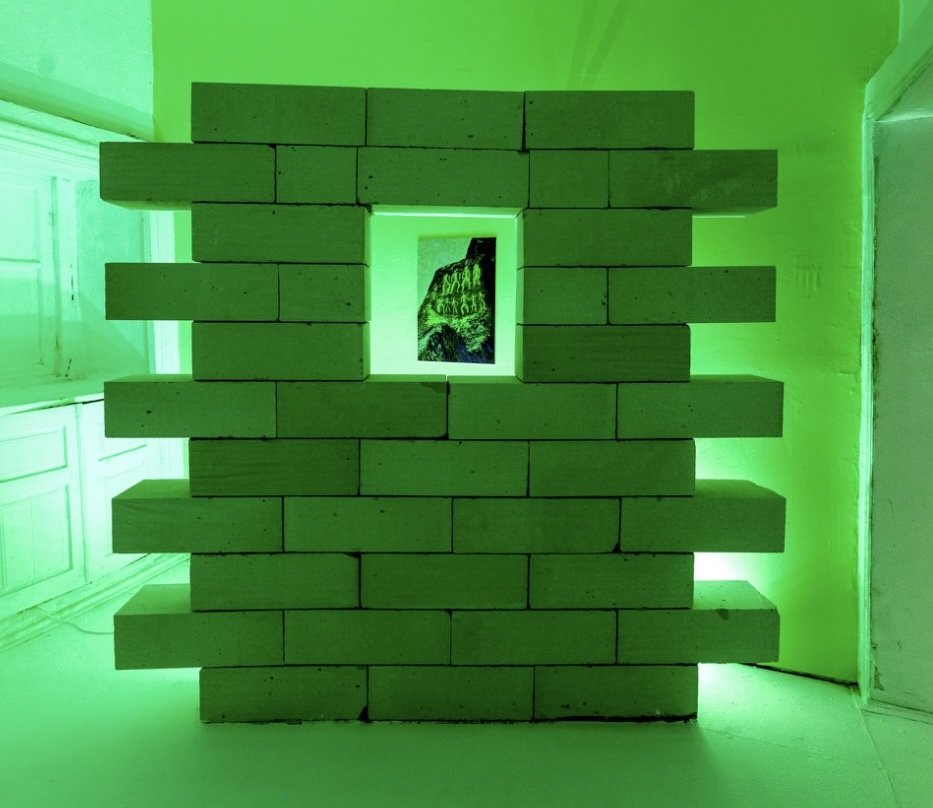
Ozan Atalan’s installation The Felt Reality questions theories of perception in a surrounding of rapid-change and information overload. The artist, however, is not interested in the cultural constructed dualism between “cyber” or “true reality”, which opposes terms such as information and logic to terms of feelings and imagination, but to look at the process of transformation as a whole, in specific how the theory of "speculative aesthetics" is proposing: “The World is both subject to human transformation and natural transformation, and from the perspective of speculative aesthetics, changes in politics and changes in nature are in a content interconnection. Taking Azerbaijan`s history and geography, and urban changes in Baku as material, my works offer an independent co-existence of natural and cultural units questioning the possibility of building a culture based on respect to nature, and ignoring the culturally constructed duality between nature and culture.”
-
Ozan Atalan’s installation The Felt Reality questions theories of perception in a surrounding of rapid-change and information overload. The artist, however, is not interested in the cultural constructed dualism between “cyber” or “true reality”, which opposes terms such as information and logic to terms of feelings and imagination, but to look at the process of transformation as a whole, in specific how the theory of "speculative aesthetics" is proposing: “The World is both subject to human transformation and natural transformation, and from the perspective of speculative aesthetics, changes in politics and changes in nature are in a content interconnection. Taking Azerbaijan`s history and geography, and urban changes in Baku as material, my works offer an independent co-existence of natural and cultural units questioning the possibility of building a culture based on respect to nature, and ignoring the culturally constructed duality between nature and culture.
Commissioned by YARAT Contemporary Art Space. Courtesy of YARAT Contemporary Art Space and the artist.
Curated by Anna Fech
Məhəllə
-
Ajam Media Collective’s ‘Məhəllə’ exhibition ran from June 8th to June 16th at the Artim Artspace in Baku.Courtesy by AJAM Media Collective. Video, article and further material can be found here
ARTIM Project Space
07 July - 30 September
2018
-
YARAT Contemporary Art Space is pleased to announce the exhibition “Məhəllə” by the Ajam Media Collective at ARTIM Project Space.
ARTIM project space features an exhibition related to the demolition of Sovietsky area in Baku and the disappearing neighborhood. The works explore themes such as nostalgia, family history, the social biography of things, displacement, the archaeology of ruins, memory and illusion.
A “məhəllə”, or a traditional neighborhood or quarter, was the main social unit for people in cities across the Middle East, Caucasus, and Central Asia. For hundreds of years people worked, celebrated births and weddings, buried their loved ones, resolved conflicts, and formed collective identities in these spaces. In Baku, these spaces of everyday life are still present, but they are slowly disappearing due to new visions of an ideal public space.
Sovetski was the quintessential “məhəllə”. Originally sheltering lower-income families who worked in Baku’s booming oil fields during the mid-19th century, Sovetsky soon became a bustling neighborhood, consisting of approximately 50,000 residents, and over 200 historic sites such as old homes, baths, and places of worship. In 2014, demolitions of the neighborhood began in order to build a public park as part of a city-wide beautification initiative.
“Ajam” Media Collective is a group of activists, scholars, journalists, and artists that focus on politics and culture in Iran, the Caucasus, Central Asia, and South Asia. Beginning as an online platform practice in 2011, “Ajam”MC has since ventured into documentary filmmaking, archival practice, and music production.
Chinara Majidova (b.1989, Baku) graduated from the International Law Department of Baku State University in 2010 working now as a writer, painter and video artist. From 2016, she worked as a photojournalist and writer with Ajam Media Collective. The collective joined her “Mehelle” project which covers the demolishing of Sovetski, a project she started because of her personal connection with the neighborhood having grow up visiting her family there.
Further material can be found here
Curated by Anna Fech in Cooperation with Fondazione Michelangelo Pistoletto
Once Again That Garden Be
-
For this edition the artist Aghababa Bagirov created the augmented reality work “Transition” that shows the story of the oil lamp when scanning the “Third Paradise” sign. The oil lamp has been often used in the regions to compensate electricity cuts. The artist takes this story as a starting point for the depiction of generation conflicts when technological progress happens too quickly and without taking social circumstances into account.
Commissioned by YARAT Contemporary Art Space. Courtesy of YARAT Contemporary Art Space and the artist
City Galleries of Gazakh, Gakh, Ganja, Michgachevir
2018/2019
-
YARAT Contemporary Art Space presents “Yenə o bağ olaydı” (“Once Again That Garden Be”) travelling exhibition in Khachmaz region with works by Aghababa Bagirov, Etibar Ismayilov, Gunay Aliyeva, Mousa Beyzade, Nazrin Mammadova, Vusala Agharaziyeva and Leyli Gafarova.
YARAT Contemporary Art Space presents Once Again That Garden Be travelling exhibition with works by renowned Italian artist Michelangelo Pistoletto and emerging local artists. The exhibition is the result of a workshop given by CITTADELLARTE Fondazione Pistoletto (Biella Italy) director Paolo Naldini discussing the theory of the “Third Paradise” developed by Michelangelo Pistoletto. The theory wants to overcome the current worldwide existing conflict between the two polarities of nature and artifice, it aims to create a new humanity with a responsibility for the own environment in harmony between technology and nature.
The Azeri word “Bağ” originates in the Persian word Bāgh (Persian: The Azeri word “Bağ” originates in the Persian word Bāgh (Persian: باغ) which refers to an enclosed cultivated area excluding wildness of nature providing privacy and security. The exhibition title is inspired by one of the most popular poems by Mikayil Mushfig talking about the garden as a desirable, nostalgic space of love, peace, freedom and happiness. The exhibition becomes a space for exploration, imagination and self-as well as social reflection, featuring works by the renowned Italian artist Michelangelo Pistoletto and by emerging Azeri artists with their visions of the paradise and harmony between technology, nature and humanity.
The exhibition includes Michelangelo Pistoletto’s labyrinth leading through a maze in search of the own self, represented in the installation with the mirror pond. The form of a labyrinth has long been used as a metaphor for discovery and personal journey.
For this edition the artist Aghababa Bagirov created the augmented reality work “Transition” that shows the story of the oil lamp when scanning the “Third Paradise” sign. The oil lamp has been often used in the regions to compensate electricity cuts. The artist takes this story as a starting point for the depiction of generation conflicts when technological progress happens too quickly and without taking social circumstances into account.
In the back part of the exhibition space the visitor finds himself amidst further work of young Azerbaijan artists and their interpretation of the Third Paradise.
Etibar Ismayilov created a wishing well with an instruction in encrypted language how to use it. The text methods refer to the fascinating capacity of human’s brain and embodies the artist’s encouragement to continue believing in the impossible.
Gunay Aliyeva's work looks at an artist’s life in the form of a receipt inspired by the words of Joseph Brodsky “our products speak about us rather than our confessions”.
Mousa Beyzade paper cuts approach the idea of the “Third Paradise” by showing how health technology has become an integral part of humanity. The work explores the fine line between the necessary compensation of health problems and the risk of the attempt of an unlimited idealization of man.
Timely, interdisciplinary, simultaneously Nazrin Mammadova’s work exists at the intersection of technology, design and nature. Pre-recorded sound ambiences were put back in their original surrounding, re-echoing and resonating with the mountains, re-creating a dense sound impression with multi-layered textures, rhythms and frequencies.
Vusala Agharaziyeva’s work presents the importance of a reasonable relationship towards high-tech features that on one hand make our life more convenient, on the other hand constitute a danger of exploiting nature. Her balance visualizes this concept consisting on one side of micro electronic devices in one scale-pan and soil on the other.
Leyli Gafarova’s multimedia project “Ghilman” (Farsi: paradisiacal, beautiful, young beardless males) refers to the theory of Dutch philosopher Michiel Leenzberg who talks about the “silent power” of the Islamic world not represented as active, political or revolutionary violent but the contrary: by its mystery, reserveness, passiveness and tolerance.
The exhibition is accompanied by a video screening program with works by Ruslan Abbasov, Gunel Akhundlu, Rena Bashirova, Timo Herbst, Orkhan Huseynov, Merzedes Sturm-Lie, Farid Rasulov.
Curated by Björn Geldhof, Head of Research Team: Anna Fech for Azeri (Sayara Huseynli), Russian (Ulvia Akhundova), Farsi (Aynur Zerintac) poems
Shilpa Gupta:
For, In Your Tongue, I Can Not Fit
YARAT Centre
26 May - 17 June
2018
-
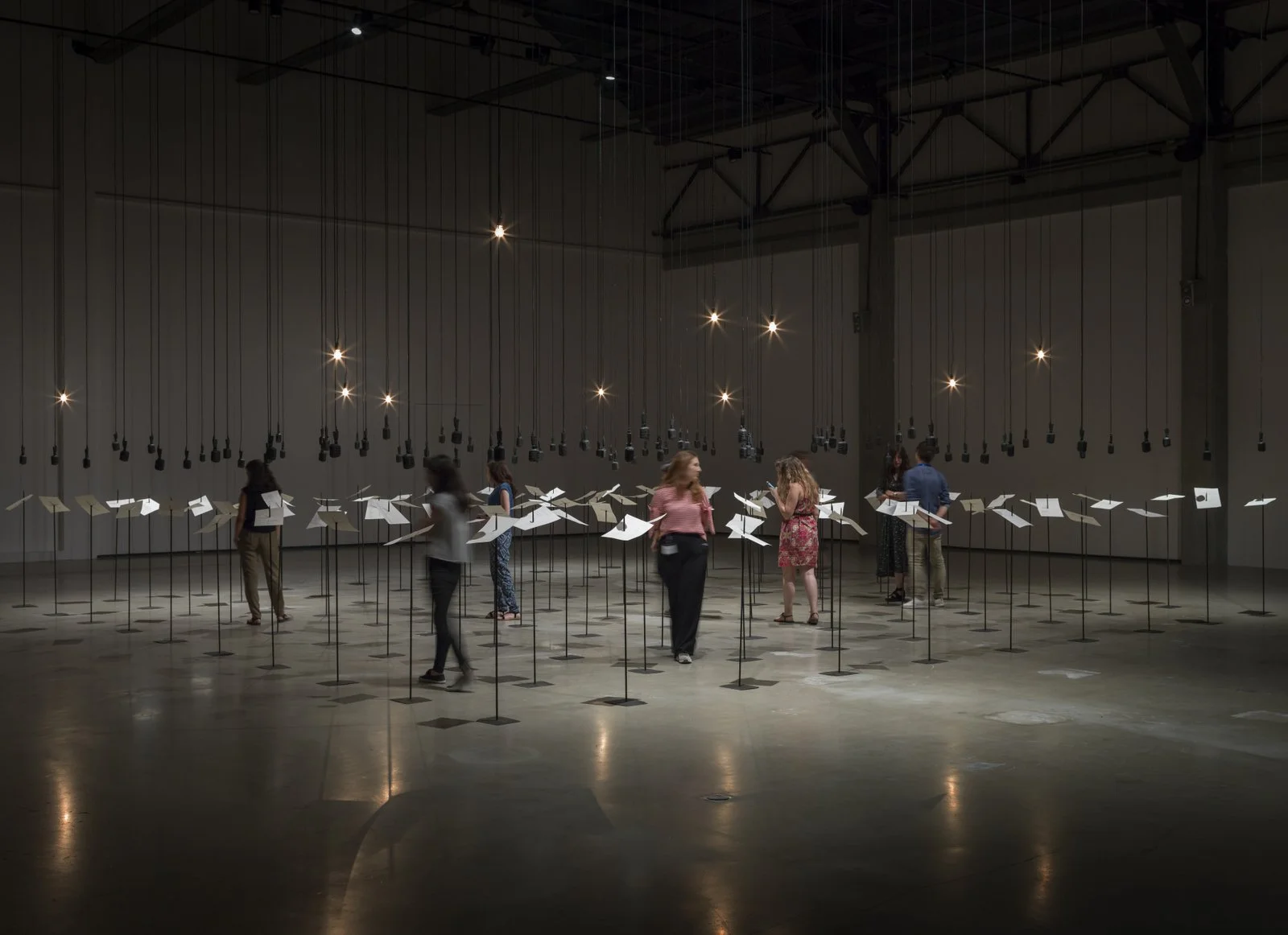
YARAT Contemporary Art Space announces a solo exhibition by internationally renowned Indian artist Shilpa Gupta. The exhibition takes its departure point from the central piece: a new, large-scale multi-channel sound installation which gives voice to 100 poets who have been jailed over the centuries for their writing or political alignments. Exhibited alongside other new drawings and sculptures, the works highlight the fragility and vulnerability of our right to freedom of expression today.
Running across the entire first floor gallery space, 100 microphones are suspended above 100 metal rods, each piercing a page inscribed with a verse of poetry. In turn, a single microphone plays these verses, echoed by a chorus of the other 99. Lasting over an hour, the sound piece alternates between English, Spanish, Arabic, Russian, Azeri and Hindi, amongst other languages. A chorus of voices shift across the space, forming an ongoing sequence of haunting recitals. The title of the installation, For, in your tongue I cannot fit – 100 Jailed Poets, is based on a poem by 14th century Azerbaijani poet Nesimi.
Alongside this major new work are a series of drawings and objects which reflect upon the lives of the poets, including a mouth cast in metal, a drawing made with thorns and tracings on paper around the body of the missing person. Telling stories of deep conflict and endearment, the works explore the political and societal restrictions which seek to control and clamp both the imagination and the physical mobility of the poets.
A motion flapboard, typically found in transit zones and transport hubs to communicate timings and schedules, hangs from the ceiling. Subverting its intended function, Gupta replaces informational text with poetry which describes processes of arrival and departure, and the movement of people and ideas. As the split-flap display rotates, new words and prose appear, offering poignant and timely reflections which in turn lead us to question how we define identity through place and time.
For this exhibition, the artist revisits her photographic series, ‘Don’t See Don’t Hear Don’t Speak’ (2006) to create a sculpture in which three identical people encircle one another, each concealing the other’s eyes, ears or mouth. Based on a Japanese proverb made popular by Mahatma Gandhi, the work sits within the context of our current changing political landscape and recent wave of separatism – a present force in the artists own home country, where agencies are often suppressed for their views. Creating a potent dialogue with the other pieces in the exhibition, Gupta’s sculpture offers a powerful reflection on freedom of expression. The artist continues: “Time and again, like where we are at today, voices of truth cause discomfort and stand truncated, however the resonances stay and they continue to be heard".
Gupta’s sound installation is a joint commission by YARAT Contemporary Art Space, Baku and Edinburgh Art Festival.
-
Gupta’s sound installation is a joint commission by YARAT Contemporary Art Space, Baku and Edinburgh Art Festival.
Image courtesy of YARAT Contemporary Art Space and the artist
Curated by Anna Fech
Double Standard
-
sound Installation, 6-90 speakers, variable dimensions
The work “Dark Lake Ritual” consists of sound ‘portraits’ of the different oil pumps on the Bibi Heybat oil fields in Baku. Each of these pumps executes mechanical movements marked by a seemingly perpetual repetition. Although they seem to move in a very similar way, the sound of each pump is unique, due to mechanical imprecisions and wear. The installation condenses the sound by reducing the spatial distance between the pumps on the field to the distance between the speakers in the exhibition space. Thus a simultaneity of sounds and rhythms is created. The pumps become individual actors of a collective ritual in a petro-industrial sound choreography across the topography of the oil fields.
The sound sample presents an excerpt of 1 min, 90 pumps playing at the same time.
The original installation foresees as many loudspeakers as there are pumps (so up to 90 speakers), thus creating a sonic field that the listener moves through (experiencing an ever changing auditive environment.
Commissioned by YARAT Contemporary Art Space. Courtesy of YARAT Contemporary Art Space and the artist.
ARTIM Project Space
21 December - 12 January
2017/2018
-
Artists: Michael Hirschbichler (Austria) and Nika Qutateladze (Georgia).
Double standard refers to the application of different sets of principles for similar situations. The term defines a normative system that rates the same behavior differently, depending for example which group a person belongs to. Both residents coming from an architectural background explored methods of observation, measurement and reconstruction creating works that imply the region’s social, ecological and economical reality.
During the three-month stay in residence Michael Hirschbichler has been dealing with the landscape transformation of the Absheron peninsula due to the oil production. With seemingly geological, scientific sobriety he collected earth samples, recorded movement noises of oil pumps, initiated a landscape transfer of a whole piece of land at Bibi Heybat. The results play with the haptic, smell and the structure characteristics of the landscapes, which are marked by their exploitation, but receive a poetic dimension through the artist’s approach giving the works a picturesque, sculptural and spiritual aura. In this cycle of works called “Black Myths” he was in search of the stories, true or false, illusive or imagined that carries the oil material in itself and open up while viewing or remain in mysterious seclusion.
Nika Qutateladze also worked with structures and measurement techniques. Based on the layout of a Soviet standard apartment such as the "Khrushchoyovka", which was developed in the 1960s to house workers, he transfers wall surfaces, ceramic walls and wallpapers into ARTIM. All pieces have the original standard lengths and width of the Soviet dwellings. The work series entitled “Home Plants on a Window-Sill” represents a brutal synthesis of architecture of two different ages and ideologies. The interior details from a late socialistic household are brought into the example of an historical dwelling house of the old city that also used to contain a household. The work not only explicitly outlines the influence of one building on the other but also questions ideologies, which try to press the population into ready-made templates.
Curated by Anna Fech
Farhad Farzaliyev: Molotov Gulab
-
Commissioned by YARAT Contemporary Art Space. Courtesy of YARAT Contemporary Art Space and the artist.
Video by Sarkhan Rajabov.
ARTIM Project Space
03 March - 17 March
2017
-
ARTIM Project Space is pleased to announce Farhad Farzaliyev’s solo show intertwining chemistry and art practice. The project is inspired by Yusuf Mammadaliyev (1905 Ordubad, Nakhchivan – 1961 Baku, Azerbaijan), grandfather of the artist, well known for his scientific inventions as a chemist, less known for his poetry that he followed with the same enthusiasm. Among his numerous discoveries during the war, one of the most famous was an incendiary mixture of chemicals that could be used to make self-igniting petrol bomb, also called Molotov Cocktail.
The exhibition will combine poetry with a performance act of throwing rose water (Gulab) embodied as Molotov Cocktails against the walls. This act of rage reveals phrases of poems that are written with Litmus papers and chemical solutions, especially developed for the exhibition, and become visible when getting in touch with liquids. Rose water is not only a reference to the artist’s grandfather place of birth but also to the symbolic meaning of gentleness, softness and love. Aside from their sensual captivity roses hold great importance for religion, to be considered as the flower of heaven. They had strong influence on history’s most famous poets, such as the great Sufi, Rumi, describing the mystical path.
The performance plays on notions of fragility, violence and beauty, kitsch and nostalgia, rage and love. It talks about contradiction, resistance and the complexity about how to deal with the traces of the past from a personal and collective perspective.
Curated by Anna Fech
Boys Don’t Cry
-
Chinara Majidova’s and Leyli Salayeva’s collaborative project Men Only (Women, Be Not Ashamed) presents twelve women reciting a poem that could be described as “vulgar poetry.” The poem consists of insulting expressions that these women have encountered from men in their real lives. The project aims to draw attention to moments in women’s lives that make them feel vulnerable and insecure. It is an attempt to shift women’s attitudes towards harassment, particularly in relation to self-blame and feelings of humiliation.
Additional note: this video went viral on social media after being published by the artist online following the opening.
Commissioned by YARAT Contemporary Art Space. Courtesy of YARAT Contemporary Art Space and the artists.
ARTIM Project Space
16 June - 07 July
2017
-
Participants: Agil Abdullayev, Anka Gujabidze, Aykhan Khalilov, Chinara Majidova, Taus Makhacheva, Jaro Minne, Leyla Novruzova, Leyli Salayeva, Gulya Novruzova
What does it mean to be a man or a woman or both? Why is it so difficult to be normal? And who decides what normal is? Boys don't cry is a multidisciplinary exhibition that combines art and literature projects exploring gender identities, rules of behavior and social structures. It talks about personal destinies and the difficulty of fulfilling both the own but also social expectations. On the other hand the project reflects on the paradox of gloating, the pleasure of gossip and voyeurism.
Rocking my Gucci is an ongoing Instagram performance by the artist Agil Abdullayev that he started in September 2016. It examines social media culture in boyhood that challenges the image of what is perceived as masculine. By the movement and the influence of a young generation of men the borders became more flexible when creating online personas through selfies, menswear and lifestyle posts.
The multimedia work by Anka Gujabidze tells the story of a transgender man called Bart. He lives in conservative Georgia where LGBTQ people are widely perceived to be in contradiction to what it means to be Georgian. “My intention is to transform ideas about identity that is an object of fear which in turn is followed by hatred and rejection. The main purpose of this project is to change aggressive and violent perception of individuals, with whom society is not familiar.”
The video artist Aykhan Khalilov investigates through a performance piece happing in two rooms how rules of behavior are created and dominated by the judgment of others. “Without these dumb rules, society would fall apart, since it is moral – behavior patterns remain the safety and functionality of society. But the question is not whether these rules are good or not. They have always been and will be. This project asks rather the question on how flexible their boundaries are.”
Chinara Majidova’s (photographer) and Leyli Salayeva’s (writer) collaborative project Men only (women be not ashamed) presents twelve women telling a poem that might be called Vulgar Poetry. This poem consists of insulting expressions that these women encountered by men in their real live. The project aims to raise attention to moments in women live that make them feel vulnerable and insecure. It is an attempt to change women attitudes towards harassments, in terms of self-blame and mortification.
Taus Makhacheva’s Let Me Be Part of a Narrative focuses on the Dagestan Dog Fighting Championship, a popular entertainment among Caucasian men. Almost always exclusively all-male event, the artist found a female dog trainer and the video concentrates on her. The footage is shown opposite a documentary material from five-time world champion Dagestani wrestler, Ali Aliev's fights. The installation draws attention to the urge for violence as a form of spectacle and the desire for fame common to all humankind. The 'underground' competition is juxtaposed with mainstream sports in a witty conversation highlighting similarities implicit in both forms.
For the ongoing project Letters of a passenger the Belgian artist photographer and filmmaker Jaro Minne takes the role of a wanderer, a stranger who immerses into private homes of people in Baku that he doesn’t know. It is a continuation of a similar ongoing project he is working on in Tbilisi. The artist is searching for a certain intensity and for spaces that describe somebody’s life, both real and imagined. His video work “čhavo” (young man) is a raw depiction of a young man coming home after months in confinement, reconnecting with his family and future wife. The enigmatic nature of the film represents a rudimentary form of narrative, exploring a sense of physical directness and romantic longing.
The project by the writers Leyla Novruzova and Gulya Novruzova tries to explore what love actually is. It is based on real people and real love stories. Why are people doing crazy things in the sake of love? Why do people who got hurt, would still go back and re-live those incredible feelings? What is better: to experience great love and lose it or never experience it in it’s full intensity?
Curated by Björn Geldhof, Assistant Curator: Anna Fech
Suns and Neons above Kazakhstan
-
Suinbike Suleimenova
Cellphone Poetry, 2015–2017
Stickers, various dimensionsThe work reflects on a new genre of poetry spawned by social media, computers, and smartphones. The artist took original texts from Instagram selfie captions and Facebook status updates to investigate our changed relationship toward machines. These devices have obtained an intimate, inevitable, and almost sacred status by being constantly involved in the ups and downs of personal life. By transferring these digital poems into physical space, Suleimenova questions human perception of virtual aesthetics and highlights how these symbols imperceptibly penetrate physical space, blurring the boundaries between the real and virtual worlds.
Suinbike Suleimenova
25 Years of Independence, 2017
Digital photographs and video installationThis documentary project, dedicated to the 25 years of independence of Kazakhstan, is a collage of realities seen or hidden in the homes of people living in Almaty. Through mute photographs and video interviews, the artist studies and witnesses the environmental, political, and personal changes people have experienced in their households since the fall of the Soviet Union.
Gaisha Madanova
#0000ff, 2017
Multimedia installationThe work centers on a live video broadcast transmitted while the artist is asleep in bed. While playing with a voyeuristic moment, it critically examines the intimacy evoked by modern technology today. Because the broadcast only activates when the artist falls asleep, the installation remains dormant for portions of the exhibition, subverting the expectation of constant digital availability. Furthermore, the work investigates the contradictory dynamics of migration as a young artist leaves Kazakhstan to live and study abroad. It addresses the complex relationship to one’s homeland, the psychological state of being in-between, and the sensation of being simultaneously absent and present.
Courtesy of YARAT Contemporary Art Space and the artists.
YARAT Centre
07 June - 29 October
2017
-
Suns and Neons above Kazakhstan brings together seminal works of the 1990s and the early 2000s, from the artists Erbossyn Meldibekov, Bakhyt Bubicanova, Galim Madanovand Zauresh Terekbay, Almagul Menlibayeva, Yelena Vorobyeva and Viktor Vorobyev, Rustam Khalfin, Said Atabekov, Creoleax Centr, Alexander Ugay as well as new commissions by emerging artists: Asel Kadyrkhanova, Nurakhmet Nurbol, Suinbike Suleimenova and Gaisha Madanova.
The exhibition aims to deconstruct a romanticized image of Kazakhstan as a vast and largely unpopulated geography that for decades played upon the collective imagination. It addresses various narratives of national history, from a post-colonial to a critical perspective, while discovering, mapping and voicing changing attitudes and concerns across generations. The exhibition explores the shifts and breaks within the construct of Kazakh national and cultural identity during a short timespan of its independence. It is an exhibition of Suns and Neons above Kazakhstan, of landscape and cityscape. Of artists dealing with history and nation building and an emerging generation concerned with private life and the emancipation of the individual within the isolated reality of city life.
Visual arts were introduced in Kazakhstan with Soviet art schools, established in the 1930s as a form of nation building. Through the 1940s, many practitioners of the avant-garde (then fallen out of favor) were deported to Kazakhstan, resulting in a surprising and mostly undocumented emergence of a non-conformist art scene. This continued through the 50s till the early 90s with strong connections to the Moscow and Leningrad non-conformist and conceptualist circles.
With the break of the Soviet Union, a radical shift took place in the Kazakh art scene. Some practices continued the conceptualist line looking at their own position as part of a Central Asian narrative, while a younger generation searched for a new language. These artists raised questions on postcolonial Central Asia, which found itself in between the revival of national and ethnic imagery and forced processes of identity construction. Playing with provocation, humor, irony and romanticism artists explored the contradictory moments within the rhetoric of authenticity, addressing national independence, recent history and social identity.
Since 1991, like other CIS countries, Kazakhstan went through various socio-economic shifts radically changing its cultural fabric. An emerging generation of artists, growing up during the booming 2000s, did not experience the nationalistic euphoria of the 1990s and do not romanticize their country's past or heritage. They are the new city kids, aware of global networks and social media, resisting confinement and societal designations around them. Their concerns are much more individual and their works draw both from illusions and disillusionments, hope and disappointments of life entrapped within the city...
This exhibition is curated by Björn Geldhof
Assistant curator Anna Fech
Research Anna Fech, Suad Garayeva, Björn Geldhof
With the support of Eurasian Cultural Alliance
Curated by Anna Fech
How Does It Feel?
-
In the last 150 years, the alphabet in Azerbaijan has changed four times, from an Azerbaijani version of the Arabic script (not modern Arabic) to Latin, to Cyrillic, and back to Latin. These changes had immense social consequences for society, for example by cutting people off from education.
This series of drawings merges these different alphabets in examples of expressions and led me to develop a public billboard film, which animates different alphabetic expressions within sentences such as:
“This palace is yours,” “mother tongue,” “how does it feel,” and “common life.”
Full video link:
Commissioned by YARAT Contemporary Art Space. Courtesy of YARAT Contemporary Art Space and the artists.
ARTIM Project Space
2 December - 16 December
2016
-
YARAT Contemporary Art Space in frame of Artim Project features the group show “How does it feel?” of the local YARAT residents Vusala Agaraziyeva and Erkin Alekberli and the international residents Gökcen Dilek Acay, Timo Herbst and Merzedes Sturm-Lie.
“How does it feel?” describes the perspective of an observer, someone who is interested in his surrounding and tries to feel his way into the different subjects. It is an observer, who is eventually overwhelmed of the different stimuli that are enclosing him and failures to find simple explanation. What happens if the foreign suddenly turns out to be the familiar or the familiar suddenly appears strange, if clear ideas evolve to be empty or the other way if the unknown takes clear shape? The exhibition combining works of three international and two local YARAT residents is a journey through the artists’ eyes constructed and at the same time each other penetrating perspectives.
Gökçen Dilek Acay’s video “Anatomical Positions” and the installation “Shaping DNA” tames parts of the human body in geometrical forms, which seems disconcerting at first. The installation shows a hair installation and kaleidoscopic records of the interior of the artist’s body commenting on the change of the body awareness in the 21st century, the fear of foreignness of the own body as well as exposure to exterior control through genetic modification. Using circles and holes as the connection point between the two works the artist plays with the tension between the body as the axis of perception and as object of voyeurism.
The focus of the installation “Absurd” by Vusala Agarazyieva is an air balloon that symbolizes pseudo-values and empty ideas and goals. The artist questions the people’s absurd behavior, the attitude to each other and to life while trying to reach the imaginary goals and what they call their truth. “I think we, the people, have turned blind and do not see that the only thing a man has is his path - the path from the beginning to the end of life, which bears no lie, envy, hypocrisy, as the nature does. Only the path built on love brings love, respect and recognition.”
With the work “Lost Generation” Erkin Alekberli aims to name the countless children lives lost in terrors of war, forgotten and stayed in the dark. The installation stands for the vanished hopes and unfinished dreams affected by the injustice of war. However, it not only accuses the unlearned lessons from bloody conflicts worldwide in which children as defenseless victims suffer the most but also tries to create a symbolic protective fence with the barbered wire forming the central part of the installation.
Timo Herbst’s drawings and video works that he started during the residency attempt to capture the choreography of Baku everyday life. In the film “Baku/Baki – Ana Dili” the artist steps into the shoes of a silent observer tracing the different living realities he was faced with allowing contradictory and complex moments to evolve. Thus, he creates a differentiated and sensitive image of the society that is more complicated than just a conflict between tradition and modernization, economical prosperity and crisis. The strategy of overlapping multiple realities he also applies in his drawings “Same procedure” that depict the bodily conflicts of political disputes around the world as well as the text works from the series “How does it feel” that play with the different alphabets used in the last two centuries in Azerbaijan.
Merzedes Sturm-Lie researched during her residency the first Azeri movie “In the Kingdom of Oil and Millions” of the year 1916 directed by Boris Svetlov, which vanished during the Bolshevik occupation in 1920. The exhibition features a documentation of her four-day workshop with young art and film students related to the movie and a video with the movie sites and an interview of the film historian Aydın Kazımzadə. The works explore the artist’s interest in the stories and the personal relationships of people related to oil and millions as well as the broader geopolitical impact that these concepts have on everyday life in Azerbaijan. The project is an extension concerns on the topic of oil that she started in Belgium with the work “Black Gold”. It consists of an oil barrel with oil at the bottom and the upper edge covered with gold leaf. Looking into the barrel it creates the feeling of looking into the dark well. The work is inspired by Friedrich Nietzsche’s quote: “And if thou gaze long into an abyss, the abyss will also gaze into thee”.
Curated by Anna Fech
Unthought Known
-
Two-channel HD video installation, Stereo Sound; (15:00) and (12:49)
See installation shoot: https://vimeo.com/268237316
The first of two opposite-facing video projections explore memory through structures that lay still within the Baku cityscape, such as the Flame Tower, Heydar Aliev Centre, Neriman Nerimanov Statue, Nobel Brother Home, the National Museum of History of Azerbaijan, National Flag Square, and the Alley of Honor. Jo then feeds these images through a virtual reality interface, in which the seams of the image and the mechanisms of control, such as the gesture of scrolling across the screen, become visible. Housing development and fashion advertisements are composited throughout this ‘other’ landscape. Contrasting grand architectural gestures against the prosaic, the first video interrogates how the modern production of spaces preserves time, yet also has the capacity to generate cultural amnesia.
Behind these ancient and modern facades, narratives are derived via the natural and artificial materials that make up the city. In the second video, the artist assumes a more documentary approach by filming landscapes composed of materials that are constantly in flux, such as water, fire, mud, oil, and also human movement. To contrast the first video, she further slows down these sceneries, which include Yanar Dag, Temple of Ateshgah, mud volcanoes, oil fields, Naftalan Clinic Baku, and the training ground of the Azerbaijan National Polo Team.
Byung-Chul Han speaks about how we live in a time of dyschrony, that time seems to drift without any direction, without any narrative, that permanent parameters giving orientation and coordination are lost. Acceleration does not bring meaningful wholeness, but lets life float undirected from one possibility to another, more hectic, confusing and directionless. Peter Handke's essay "The Temptation of Fatigue" from 1989 describes the vita contemplativa, a chamber of identity, fatigue, hesitation, waiting, experiencing and ultimately of regaining time. In Jo’s work our gaze wanders over to one side of the video installation as we observe lazy bubbling mud volcanoes, slowly burning fire tongues or slowed-down movements of the polo game players. The beauty of the moment, the slowness captures all our attention. And then we feel again the gravity of this slowness and the unrest of our mind, which calls for new stimuli and leads us to return to the projection of the digitally manipulated world.
Commissioned by YARAT Contemporary Art Space. Courtesy of YARAT Contemporary Art Space and the artists.
ARTIM Space: YARAT Residents
25 April - 11 May
2018
-
Hiba Farhat (USA/Lebanon), Clara Jo (USA/ Germany) and Ehtiram Jabi (Azerbaijan).
The term “Unthought Known” refers to a psychological concept of knowledge that the individual person is not actively aware of. The “unthought” stands for early-learned schemata of interpreting the objective world; it can be shaped by early experiences, traumas or dreams that unconsciously determine our perception and actions. In the exhibition the works approach subjects that deconstruct repetitive structures such as memory, history, language questioning concepts of perception, knowledge and reality.
Hiba Farhat’s work “Lobster Paradise” builds on one particular Baku dream. While on a three-hour flight from Dubai to Baku, Ibrahim Ibrahimov closed his eyes and had a dream in which he envisioned a future city off the coast of Baku manifested in the form of a gigantic lobster. ‘Lobster Paradise’ recreates this dream to then subvert it within the present moment of a post-oil crash Azerbaijan. The work places side by side individually familiar but unrelated objects that start to radiate oddness. Through a conjunction of items not normally associated with each other, something both playful and menacing occurs. ‘Lobster Paradise’ elides an allegorical reading, the emotions it tries to stir and the fallacies it attacks are too real. It draws out an illogical world to its most logical ends.
Clara Jo’s short film excavates the layers of history embedded within various mnemonic and architectural landscapes in and around Baku. Behind these ancient and modern facades, narratives are derived and accumulated via the natural and artificial materials that make up the city. Contrasting grand architectural gestures against the prosaic, the film interrogates how the modern production of spaces preserves identity, yet also has the capacity to generate cultural amnesia.
Ehtiram Jabi’s project “Polio” is autobiographical and talks about his childhood memories dominated by dirty hospital rooms, doctors, painful treatments and despair. Compared to other patients his sickness was a mild form, but he still felt a deep psychological impact, deprivations and memories are accompanying him everyday of his life. The installation consists of a wooden construction with photographs of the “Polio” series inside that formally relates to the hospital corridors but also to the bonds of the trauma. The second room contains real objects hanging on a wall representing his life outside the hospital, but are still associated to restrains due to is illness. Coming from photography the artists explores the first time different medias to reflect on the medium of photography and notions of fragility, ephemerality and reality.
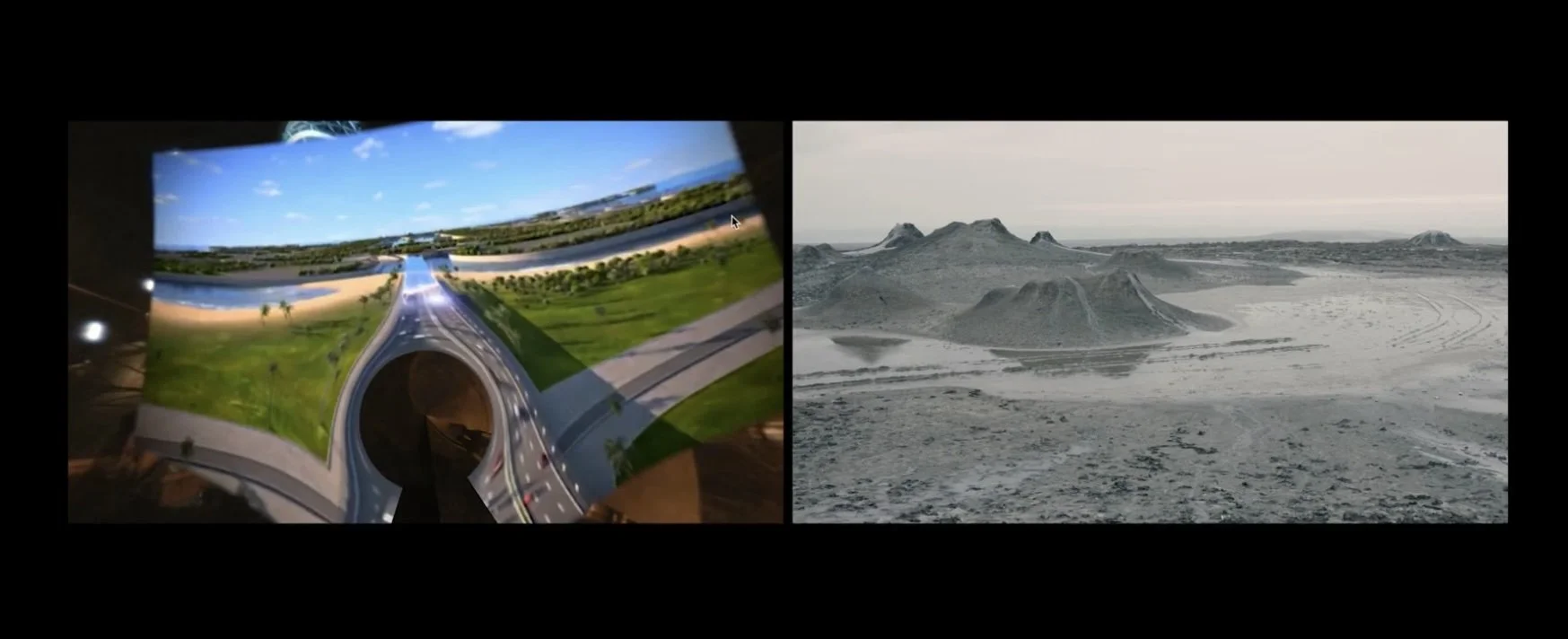
Curated by Anna Fech
Vusal Rahim:
Nurcan
ARTIM Space: Soloshow
25 April - 11 May
2018
-
YARAT Contemporary Art Space is pleased to announce the solo exhibition by Vusal Rahim “Nurcan”.
Together with participants of the performance and activists fighting against forced marriages of minors Vusal Rahim will explain his exhibition project "Nurcan".
The implementation of this project supports social work to increase sensitivity to the topic of early marriages, explaining the importance of this problem to the society as well as establishing a virtual discussion platform. Causes of early marriages are diverse and include poverty, the fear of remaining unmarried, social pressures and costumes, insecurity or financial advantages. Women married in their teens struggle with an increase of birth complications, social isolation, limited possibilities of education and suffer more likely from domestic violence and marital rape.
Vusal Rahim was born in 1987 in Ganja, Azerbaijan. In 2011 he graduated from the Azerbaijan State Academy of Fine Arts from the department of “Theater and Decorative Design”. His works include a wide range of medias such as painting, video, photography and sculptures exploring topics such as body, gender and social structures. Aside from Azerbaijan his works have been featured in Russia, USA, Georgia and France.
ARTIM is directed at young Azerbaijani artists with an intention to support and encourage emergent talent to grow. The program has a designated exhibition space in Icheri Sheher that was conceived as a platform for experimenting and professionally showcasing art. Artworks resulting from the program are exhibited at the ARTIM Project Space, Baku.
-
Vusal Rahim: Nurcan (2018)
Commissioned by YARAT Contemporary Art Space. Courtesy of YARAT Contemporary Art Space and the artist.
Video by Sarkhan Rajabov.
Curated by Anna Fech
DissemiNation
Stadtgalerie Brixen
In Kooperation mit dem Südtiroler Künstlerbund
16 May - 5 June
2015
-
Künstler: Stefan Alber, Arnold Mario Dall'O, Käthe Hager von Strobele, Hubert Kostner, Erbossym Meldibekov, Gulnur Mukazhanova, Judith Neunhaeuserer, Slavs and Tatars, Alexander Ugay.
Die diesjährige Ausstellung des Südtiroler Künstlerbundes in der Stadtgalerie Brixen widmet sich den Fragen von Zugehörigkeit und Identität.
DissemiNation diskutiert und hinterfragt die „Nation“ und mit ihr in Verbindung stehende Begrifflichkeiten wie Tradition, Zugehörigkeit und Identität. Durch Begegnungen, Dialoge und Austausch zwischen den KünstlerInnen, aber auch mit der regionalen Bevölkerung, widmet sich das Projekt dem Versuch bipolare Denkstrukturen aufzubrechen und einen Raum zu schaffen, der vielschichtige Situationen und die Koexistenz von Widersprüchen zulässt.
In Lexika wird die Nation gerne als «ethnische Gemeinschaft» bezeichnet, die verbunden ist durch homogene Merkmale z.B. gemeinsame «Geschichte, Kultur, Sprache, meist innerhalb eines bestimmten Territoriums». Wie schnell diese Definition an ihre Grenzen stößt wissen Südtirol, aber auch Länder Zentralasiens zu berichten, die nach dem Zerfall der Sowjetunion wieder stärker mit Thematiken der Identitätsfindung konfrontiert sind. Bei beiden Regionen resultierte aus der wechselhaften territorialen Geschichte, der Umsiedlungspolitik und dem Zusammenwachsen unterschiedlicher Kulturräume eine Bevölkerungszusammensetzung, bei der Fragen nach Zugehörigkeit und Herkunft nicht einfach zu beantworten sind. Aktuelle Entwicklungen wie die Globalisierung und Migration machen die Thematik noch komplexer.
Der Titel dissemination (engl. Verbreitung, Verteilung, Streuung) ist angelehnt an den Philosophen Jaques Derrida, der beschreibt dass ein Text jedes Mal, wenn er gelesen wird, eine neue Bedeutungsebene entfaltet und deshalb in seiner Interpretierbarkeit niemals erschöpft sein kann. Homi Bhabha, einer der Schlüsselfiguren der postkolonialen Theorie, überträgt diese Idee der unabschließbaren Interpretation auf den Begriff der Nation, um ihn als ein statisches und eindeutiges Konstrukt in Frage zu stellen. Dem Theoretiker geht es um die komplexen Strategien kultureller Identifikation, die eine widersprüchliche Verortung des Subjekts zulassen, weil sie von Ambivalenzen und doppelten, wenn nicht sogar multiplen Sichtweisen definiert sein können.
Basierend auf dieser Theorie soll die Ausstellung einen Versuch darstellen jenseits klarer Landes- und Denkgrenzziehungen zu gehen. Binäre Strukturen werden zugunsten eines Raumes aufgegeben, der widersprüchliche und komplexe Situationen legitimiert. Anstelle eines „Sammelns“ und „Ordnens“ spielt die Ausstellung daher mit der Idee des „Zerstreuens“ und „Verteilens“.
Die KünstlerInnen thematisieren die Relativität von Zugehörigkeits- und Identitätsfragen und ihren transformativen Charakter im Laufe der Zeit. Aufgriffen wird auch die Heimat als ein Nicht-Ort bzw. die Kumulation von mehreren Orten, aber auch Menschen, Beziehungen, Emotionen, die nicht eindeutig lokalisiert, sondern verzweigt und zeitlich parallel stattfinden kann. Die Werke hinterfragen Klassifikations- und Einordnungssysteme, welche angewendet an der Realität zum Scheitern verurteilt sind und zeigen wie sich Individuen in Kollektiven unterschiedlich situieren und dadurch ein vielschichtiges und anstelle eines kohärenten Bildes von sich zeichnen. Polare Schemata werden befragt und wie sie die Abgrenzung von Ich/Anderer fördern sowie zur Konstruktion des Selbst/Fremden beitragen. Ebenso diskutieren Werke das Problem ein künstliches und einheitliches Bild für die Außenwelt zu kreieren, das häufig aus Stereotypen und idealisierten Vorstellungen besteht und letztlich zu Selbstvermarktungszwecken dient. Aufgegriffen wird auch in diesem Zusammenhang der Begriff der Tradition und die Frage inwieweit in Zeiten der Globalisierung diese nur noch künstlich für touristische Zwecke erhalten werden, wenn parallel eigentlich seit Generationen überlieferte handwerkliche Tätigkeiten in Vergessenheit geraten.
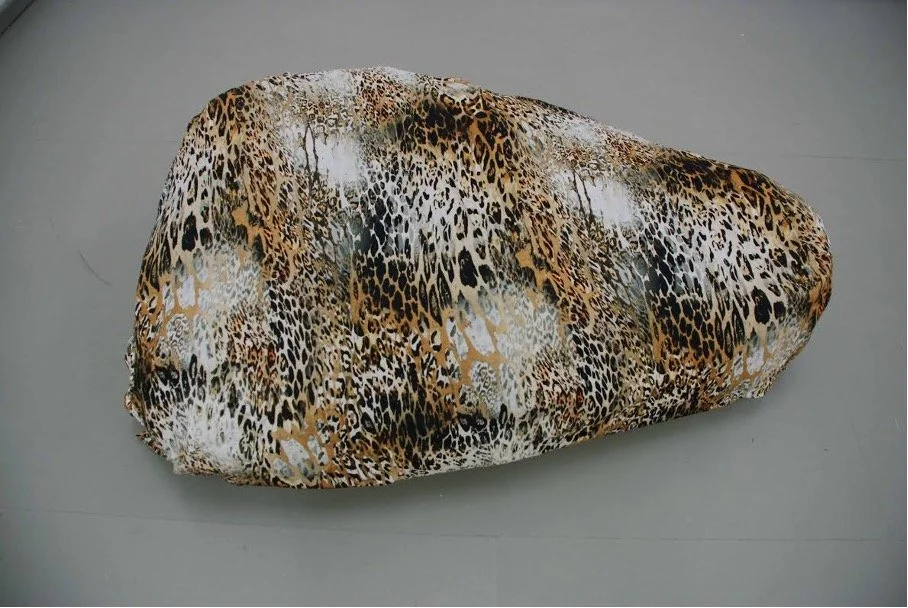
-
Textile Design
Mimaki textile print (plot)
200 × 150 cmA society’s identity is often produced by stereotyped images of the ‘Other‘ and the ‘Self’. According to Stuart Hall, these stereotypes are always created through opposites with cultures or nations often defining themselves against each other. The phenomenon of ‘Chiku’, the semi-domesticated cat, serves as a medium through which to explore and discuss these identity constructs. Chiku has been domesticated for a home environment and the natural predator is hidden, but once the cat appears dangerous it has to be removed from the home and the country. The resulting discourses in the media demonstrate how the preservation of one thing can articulate the intentions of the dominant ruling perspective of a society as well as refer to hidden cultural heritages that co-exist within that country.
Commissioned by Südtiroler Künstlerbund. Courtesy of Südtiroler Künstlerbund and the artists.